

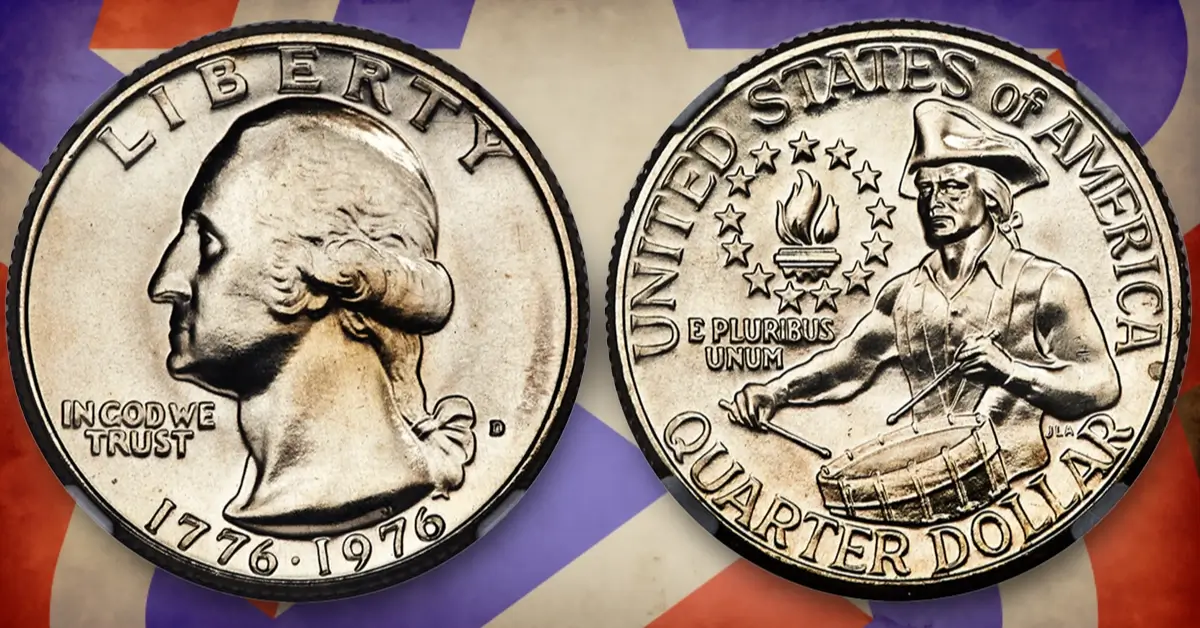
The 1976 Bicentennial Quarter stands out among modern U.S. coins not just for its iconic design but for the potential value hiding in plain sight.
Minted to commemorate the 200th anniversary of American independence, this coin was released in massive quantities—but as any seasoned collector knows, the rarer varieties, errors, and high-grade pieces command far more than their face value of 25 cents.
In this article we will explore everything from design and composition to mint marks, silver strike versions, error varieties, grading, and auction records.
By the end you will know how to spot a valuable 1976 quarter, understand what drives its value, and gain expert-level insight into one of the most accessible yet fascinating coins in U.S. numismatics.
What Is the 1976 Bicentennial Quarter and Why It Matters
In 1976 the United States celebrated the nation’s bicentennial, 200 years after the Declaration of Independence in 1776.
To mark the milestone the United States Mint issued special coin designs including the quarter featuring the dual date “1776-1976” and on the reverse a colonial drummer boy alongside a victory torch encircled by thirteen stars. The obverse retained the profile of George Washington.
The production run was enormous: over roughly 1.6 billion quarters were struck for circulation between Philadelphia, Denver and San Francisco mints. Because of this high mintage most of these coins remain common and trade only at face value or a small premium.
Nonetheless, the bicentennial quarter design has become iconic for its historical context, design significance, and numismatic appeal—making it a prime search target for collectors checking through pocket change or bank rolls.
The coin also matter because it marks a clear design change: it was the first time Washington’s profile appeared on a quarter with a dual date, and the reverse moved away from the traditional eagle motif to something more symbolic of America’s bicentennial celebration.
For collectors this combination of symbolism, accessibility and the potential for rarities makes the 1976 Bicentennial Quarter an enduring favourite.
Key Features That Determine Value
Several core factors determine the value of a 1976 Bicentennial Quarter. Understanding these features is essential.
Composition & Mint Marks
The standard circulation version of the 1976 quarter was struck in copper-nickel clad (91.67 % copper, 8.33 % nickel) and circulated widely. However, certain collector editions (notably from the San Francisco mint with an “S” mint mark) were struck in 40 % silver for special sets.
The presence of the “S” mint mark, or a “D” for Denver, or no mint mark (Philadelphia) is a significant indicator. For example coins marked “S” that are silver business strikes (outside of federal proof sets) are extremely rare and command premium values.
Condition also interacts heavily with mint mark and composition. Even two coins with identical mint mark and composition can have wildly different values depending on grade.
Collectors also look at subtle differences: an error coin struck on a wrong planchet (for example, a silver blank instead of clad) or with doubling or off-centre features can increase value substantially. These are rare but drive many of the headline price records.
Condition & Grading Scale
Condition is a primary driver of value for coin collecting in general and certainly for the 1976 Bicentennial Quarter.
Grading agencies like the Professional Coin Grading Service (PCGS) and Numismatic Guaranty Corporation (NGC) assign grades such as MS (Mint State) and PR (Proof) followed by a number (e.g., MS70, PR70) that convey the coin’s level of preservation, luster, strike quality and absence of marks.
A common circulation coin from 1976 might grade MS60 or less and trade near its face value or a modest premium. In contrast, a coin graded MS68 or better, or a PR70 Deep Cameo proof version, can trade for thousands of dollars due to scarcity in that grade.
Condition also affects appeal; collectors look for full original luster, minimal bag marks, excellent strike detail, and eye appeal (toning, color and surface quality). A lower-grade coin may still have historic value but will command a far smaller price.
Read Also: occ ofc
Rare Silver Strikes and Collector Editions
Some of the most sought-after versions of the 1976 Bicentennial Quarter are the silver strikes and collector editions that deviate from the everyday circulation pieces.
1976-S 40% Silver Business Strike
A particularly rare variety is the 1976-S quarter in 40 % silver composition that appears to have escaped the standard proof sets and entered circulation—or at least has appeared in the market.
These coins typically feature the “S” mint mark and have a silver edge rather than the clad copper stripe, and they weigh slightly more (around 5.75 g rather than the 5.67 g clad version).
Because the majority of 1976 quarters were clad, silver business strikes represent a production anomaly or limited release. Auction records show these coins trading in the range of tens of thousands of dollars when verified and graded in high condition.
For example one such coin sold for nearly $20,000. (Note: value depends heavily on certification and provenance.)
Proof Sets and Deep Cameo Examples
Beyond business strikes, the San Francisco mint produced proof sets where the 1976 quarter was struck in a special finish (PR grade) with mirror-like fields and frosted design elements, often referred to as Deep Cameo. These coins were intended for collectors and seldom entered circulation.
A proof 1976-S Bicentennial Quarter in PR70 Deep Cameo condition can command a premium, not just for the silver content but for the superb quality. Collectors prize these as high-end type coins for modern quarter type sets, registry sets and silver strike sets.
Though less rare than the business strike anomalies, they remain a core segment in the market.
Common and Rare Error Varieties
While most 1976 bicentennial quarters are common, errors and unusual production varieties drive much of the excitement and value potential.
Error varieties include: coins struck on wrong planchets (e.g., a nickel or dime blank), off-centre strikes, doubling on the die (double die obverse or double die reverse), and other anomalies like clipped planchets or wrong metal composition.
Many modern resources list error coins for the 1976 quarter specifically. For example, a doubled die obverse known as FS-101 for the 1976-D quarter has fetched several thousand dollars in high mint state grades.
Because over 860 million 1976-D quarters were made, the error examples among them are incredibly scarce in high grade. Collectors often sift through rolls, bank bags or old change vaults hoping to find such anomalies.
Recognising the features of these errors—such as obvious doubling on the word “LIBERTY,” part coins struck on dime or nickel planchets—is pivotal. The rarity of a correctly attributed error plus high grade condition can lead to values far beyond typical market levels for this coin series.
How to Identify a Valuable 1976 Quarter
Identifying a valuable 1976 Bicentennial Quarter involves a systematic approach.
First, check the date and design: the coin should bear the dual date “1776-1976” and the reverse should show the drummer boy and victory torch design rather than the traditional eagle. Next, look for the mint mark: “S” for San Francisco, “D” for Denver, or no mark for Philadelphia.
Then examine the edge and weight: a true 40 % silver business strike will lack the copper stripe present on clad coins and will weigh slightly more.
Remove the coin from circulation conditions: look for high luster, minimal surface marks, strong strike detail and excellent eye appeal. Use proper magnification to inspect for doubling, off-centre strikes or wrong planchets.
If you suspect a rare variety, consider certification by a reputable grading service (PCGS, NGC) to validate condition and authenticity. Preserve the coin properly: do not clean it, as cleaning can severely reduce value. Use inert packaging such as mylar flips, coin capsules or archival coin holders.
Finally, compare recent auction prices for similar coins (same variant, composition, grade) to understand its market value. Regular circulated examples may only be worth face value or a small premium; a mis-identified high-value coin won’t fetch top dollar without proper verification.
Auction Records & Market Trends
Over the past decade, market trends for the 1976 Bicentennial Quarter have shifted markedly as collectors pursue modern coins with rarity, high grade and provenance. Auction houses have recorded sales in the thousands of dollars for key varieties.
For example one silver 1976-S business strike sold near $19,200 according to recent listings, making it the most expensive Bicentennial quarter yet publicly recorded.
Error varieties such as the ::FS-101 doubled die have fetched several thousand dollars in high mint state grades. Standard mint state clad coins graded MS68 also have traded in the low thousands—a striking contrast to the face value of 25 cents for circulation examples.
This movement reflects increased demand for modern coins in premium condition and growing awareness among newer collectors of what to look for. Collectors also increasingly value coins with low population reports (few examples certified) or strong provenance.
The overall market remains healthy but selective: condition, rarity and authentication remain key. Pricing can fluctuate based on grading trends, auction exposure and global economic factors affecting collector budgets.
Collecting Tips and Preservation Best Practices
If you are considering collecting or simply evaluating a 1976 Bicentennial Quarter from your change or collection, follow these tips. Store coins in climate-controlled environments away from extreme heat, humidity or direct sunlight.
Handle coins by the edges only, using gloves or finger cots when possible to avoid oils and fingerprint marks. Avoid cleaning coins, as even mild cleaning or polishing can reduce their numismatic value substantially.
For coins you suspect are rare (silver variety, error variant, high grade), consider third-party grading for authenticity and condition guarantee. When purchasing, verify the certificate number, population report, and recent comparable sales to ensure you’re paying a fair market value.
Keep documentation: photographs, grading reports, purchase receipts and provenance can add value when reselling.
Join numismatic forums and communities to stay current on market trends, newly discovered varieties and upcoming auctions. Lastly, enjoy the hobby: even if you don’t find a multi-thousand dollar coin, the process of examining coins and learning the subtleties of minting, errors and design is rewarding.
Final Thoughts
The 1976 Bicentennial Quarter may have started as a common 25 cent piece, but through careful inspection and collector-driven demand, it has become a fascinating entry point into modern coin collecting.
Whether you stumble upon an error struck on a dime planchet, an ultra-rare 40 % silver business strike, or a pristine proof graded PR70 Deep Cameo, the combination of history, design, and value potential makes this coin truly special.
By knowing what features matter—mint marks, composition, condition, errors—and by staying informed on auction trends and certification standards, you position yourself to separate everyday pocket change from genuine numismatic opportunity.
So next time you come across a 1976 quarter, take a moment, look at the details — you might just be holding more than 25 cents.
FAQs
What is the difference between a 1976-S silver Bicentennial quarter and a regular 1976 quarter?
The 1976-S silver version is struck in 40 % silver and intended for collectors; it is far rarer and often worth thousands compared to the standard copper-nickel clad version.
How can I tell if my 1976 Bicentennial quarter is an error variety?
Look for anomalies such as doubling on the lettering (double die), off-centre strikes, wrong planchets (e.g., coin struck on nickel or dime blank), and compare weight and edge to known standards.
Is a circulated 1976 Bicentennial quarter worth anything above face value?
Most circulated examples are worth only face value or a small premium unless they have rare composition or error features; condition and rarity drive higher value.
Should I get my 1976 Bicentennial quarter graded?
If you believe it is a rare variety (silver strike, error, high grade) then yes—grading adds verification and can significantly affect resale value; for common coins grading may not be cost-effective.
What mint marks on a 1976 Bicentennial quarter should I look for?
The coin may have “S” for San Francisco, “D” for Denver, or no mark (Philadelphia); “S” silver business strikes are especially desirable for collectors.
